

By Tracy Gupton
Watching an old rerun of the 1960s Andy Griffith Show recently brought back memories from my youth. Sheriff Andy Taylor was telling a group of young campers that included his son Opie about a Mayberry, North Carolina, ghost story that had been passed from generation to generation. While the kids gathered around a campfire listened intently to Andy, he told of an old hermit who had lost his arm in an accident and, after being buried in his grave, roamed the woods around Mayberry at night in search of his missing arm.
One of the popular ghost stories that has survived to the present day in the West Columbia area had its origin in the mid-19th century. My Dad told it to me and my siblings when we were kids in the 1960s, and his Daddy probably told it to him in the 1920s. According to “True Ghost Tales of Brazoria County,” the late Catherine Munson Foster of Angleton was popular for visiting elementary schools around Brazoria County and retelling several of her favorite scary stories.
“It is said that the highway that connects Angleton and West Columbia (and also runs through Bailey’s Prairie) is haunted by the ghost of one James Briton Bailey, for whom the area was named,” Mrs. Foster wrote many years ago. “According to legend, the ghost, carrying a lantern, roams across the flat land of Brazoria County at night, constantly searching for a jug of whiskey. It appears as a bouncing, white ball of light floating about four to six feet off the ground, occasionally making an appearance somewhere between West Columbia and Angleton. A large number of folks have seen the phenomenon known as Bailey’s Light.”
Singer-songwriter Zack Walther of West Columbia has recorded a song about “Bailey’s Light” on one of his Zack Walther Band albums. Zack and his bandmate Matt Briggs are both graduates of Columbia High School who grew up in the West Columbia-Brazoria area and obviously had the ghost story of Brit Bailey told to them. Most likely the two popular San Marcos area musicians were among the thousands of young students who were lucky enough to have Catherine Munson Foster visit their school to talk about her favorite ghost stories.
In her book she had published in 1977 by the Texian Press of Waco, “Ghosts Along the Brazos” (with illustrations by Ruth Munson), Catherine Munson Foster dedicated the well-received book to “the ghost of Brit Bailey I respectfully dedicate this little book with the hope that someday soon he will find his lost jug and at long last can stand easy in his grave.”
“This book is a must read for anyone living in Brazoria County, feeling that folklore is as much a part of our heritage as history itself,” was written inside the front cover of the Ghosts Along the Brazos book I borrowed from the West Columbia Public Library last week. “This author has put together an extraordinary collection of ghost stories for all ages and they are all here locally.”
In the preface to her book, Mrs. Foster wrote, “These are stories that I have been telling to groups, both children and adults, throughout Brazoria County for more years than I care to remember. And for almost as long, people have been urging me to write them down.” She said in her book that, “A legend, after all, is a tale handed down by word of mouth from the past and everyone who repeats it adds something to it. I have felt I could count on my audiences, especially the children, to tell and retell the stories, limited in the telling only by the extent of their imaginations.”
Bob Arnold titled his 2011 book about East Columbia and West Columbia founders Josiah and Mary Bell “First in Texas” because his ancestors the Bells came to Texas in the early 1820s with Stephen F. Austin. However, James Briton Bailey was here long before Austin and the Bells ever laid eyes on the beautiful scenery present day Brazoria County provides, having arrived in Texas in 1818.
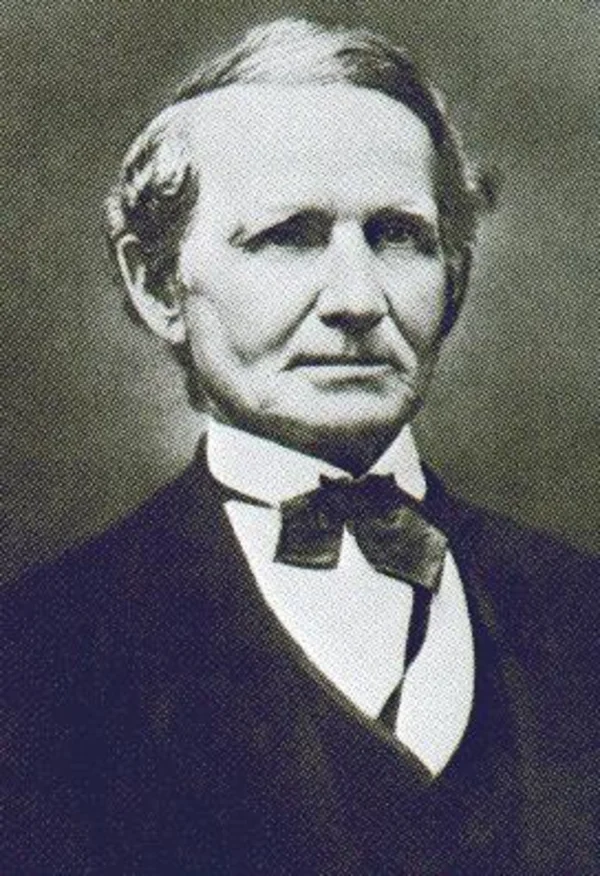
Former West Columbia High School teacher James A. “Deacon” Creighton writes in his “A Narrative History of Brazoria County, Texas” about Bailey, “Another citizen of Brazoria County who arrived prior to 1822 was James Briton (Brit) Bailey. He also was a veteran of the War of 1812 (along with early Anglo Texan George Smeathers or Smithers), and when he came to Texas he brought with him his wife and six children. He was the first to raise a pole cabin on the prairie now named for him (Bailey’s Prairie). According to family records, he was a descendant of the famed Robert Bruce of Scotland. Because of his colorful personality and individualistic eccentricities, legends have gathered about the memory of Brit Bailey like a tail streaming from a comet. It is said that he was buried standing up, as provided for in his will, ready to confront without fear whatever might come.
“The legends about Bailey have obscured to some degree his solid accomplishments as a citizen of Brazoria County,” Creighton goes on to write abot Brit Bailey in the history of Brazoria County he had published in 1975 by the same Waco publishing house Foster used to publish her book of ghost stories. “His claim to land near the Brazos River was recognized on July 7, 1824, and he became a member of the Old 300 at that time (despite having already been living here when the other Old 300 members arrived). In the same year Bailey was elected a lieutenant in the militia and was later promoted to Captain by Governor Viesca.
“Bailey took part in the battles of Jones Creek and Velasco, but he was not at San Jacinto, for he died in 1833, the year of the cholera in Brazoria County,” Creighton wrote.
According to “The Handbook of Texas,” James Briton Bailey was in Texas before Stephen F. Austin’s Old 300 colonists had arrived. He was born in North Carolina in 1779, was married at a young age and they had six children. After his first wife died, he married her sister and fathered five more children.
As a young adult living in Kentucky, Bailey served in that state’s legislature. After leaving Kentucky, Bailey turned up in Tennessee where he and his wife and children lived for a number of years. After he fought in the War of 1812, Brit Bailey moved his family and six adult slaves to Texas, according to Mrs. Foster’s writings on him. “He settled on land that would later become part of Brazoria County,” Mrs. Foster wrote. “That specific area is now known as Bailey’s Prairie.”
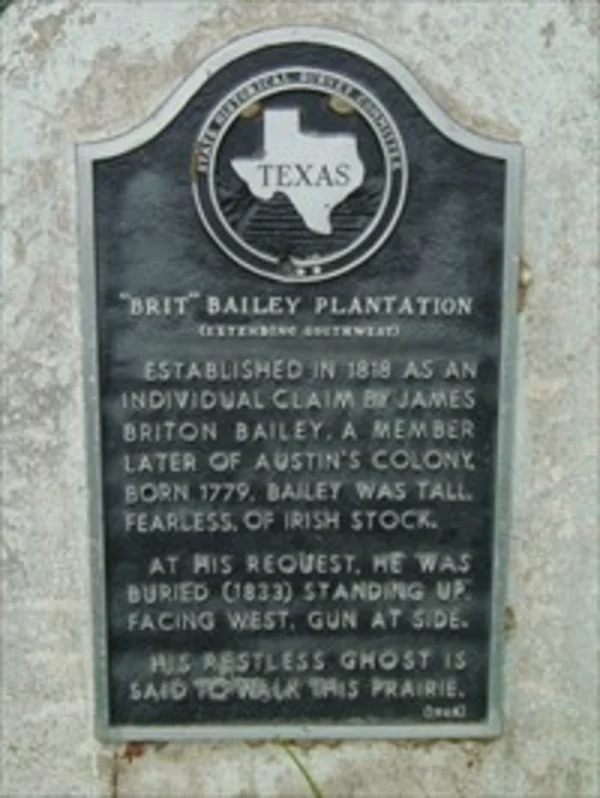
Mrs. Foster wrote that, according to legend, “(Bailey) also wanted his rifle at his side and a jug of whiskey at his feet” when he was buried standing up. “There are those who say that the will also stated that he wanted his gun over his shoulder and his powder horn at the ready. Others say that his favorite hunting dog was to be buried with him. One hopes that the poor animal was to be killed before being buried, but as to that detail no one seems to have any data.”
Mrs. Foster wrote that “The reasons Brit is said to have given for these novel requests are as many and varied as the stipulations themselves. He has been quoted as saying that he had been going west all his life and still wanted to be facing in that direction when he crossed the great divide. Moreover, he had never stooped to any man and wished to remain erect even in death. Neither did he want anyone to pass his grave and say, ‘There lies old Brit Bailey,’ and as long as he was standing up he figured they would be forced to say instead, ‘There stands Bailey.'”
In “Ghosts Along the Brazos,” Catherine Munson Foster wrote that the first time Brit Bailey’s ghost appeared, as far as anyone seems to know, was not as a bright light but rather “in a form much like his living body.” John Thomas bought Brit Bailey’s land a few years after Brit died on December 6, 1832. It was in 1836 that Thomas’s wife Ann was frightened out of her wits one night when her husband was away. She awoke in the middle of the night and saw standing in a far corner of her bedroom the figure of a man. “As the figure moved toward her she could hear footsteps, lightly, as if someone wearing carpet slippers was walking on a thick rug, and this frightened her even more because the feet of the figure didn’t seem to be touching the floor. Now the ghostly figure came near to the bed, reaching out its arms toward the terrified girl. She could almost feel those cold dead hands, but they didn’t quite touch her. With the ghost’s departure the awful cold that had filled the room was gone, too.”
Ann Thomas later was informed that the room she had been sleeping in had been Brit Bailey’s bedroom.
Mrs. Foster said that Brit’s widow, Dorothy Bailey, “carried out his instructions to the letter” when he died, having her husband buried standing up facing the setting sun “in a pecan grove near the house.”
“He’s not going to have it,” Dorothy Bailey allegedly told slaves who tried to place a jug of whiskey in the ground with Brit Bailey’s body as he had requested. “He had enough of that stuff on this earth and he’s not taking any of it with him no matter where he’s going.”
Legend that has passed from generation to generation from 1833 to the present day evolves around the theory that Bailey’s ghost continues to roam the woods around Bailey’s Prairie. “He’s still out huntin’ dat jug of whiskey,” Mrs. Foster told elementary school children and adults alike in her presentations about ghost stories of old Brazoria County.
“Down through the years the light has been seen repeatedly, and the stories have grown with the telling,” said Catherine Munson Foster in her book.
If any of you have stories about seeing “Bailey’s Light” at night while driving the highway between West Columbia and Angleton in the Bailey’s Prairie area, add a comment to this story. Leave your name and email address and your comments will be posted on the Columbia Historical Museum’s website.
