

By Tracy Gupton
On Veterans Day, November 11, 2025, the Columbia Historical Museum and the Columbia Cemetery Association jointly recognize the bravery and sacrifice of the nine men buried at historic Columbia Cemetery who volunteered to join in the Texians pursuit of independence from Mexican rule 190 years ago. The Texas Revolution war was fought from October 1835 to April 1836 between the nation of Mexico and Texas colonists. The Texians’ victory on April 21, 1836, at San Jacinto resulted in Texas’s independence from Mexico and the founding of the Republic of Texas.
As president of the Columbia Cemetery Association, I was recently informed by the Texas Historical Commission that the CCA’s application for a new state historical marker honoring Thomas Dodson Cayce has been approved. A special ceremony at Columbia Cemetery in West Columbia dedicating the newest historical marker at our historic graveyard will be scheduled sometime in 2026 when the Cayce marker arrives. The local cemetery board of directors plans to pursue another state historical marker in the not-too-distant future for Dugald McFarlane, another early Texas hero who is interred at Columbia Cemetery.
Columbia Cemetery, located between East Jackson Street and Loggins Drive in West Columbia behind Barta Lumber Company, is already the home of multiple state historical markers recognizing the heroics of several other men who fought in the Army and militias for the Texas colony that eventually became a republic in April 1836. The first capital of the Republic of Texas was located right here in West Columbia, which was simply referred to as Columbia at the time our little town was the first capital in 1836 and 1837.
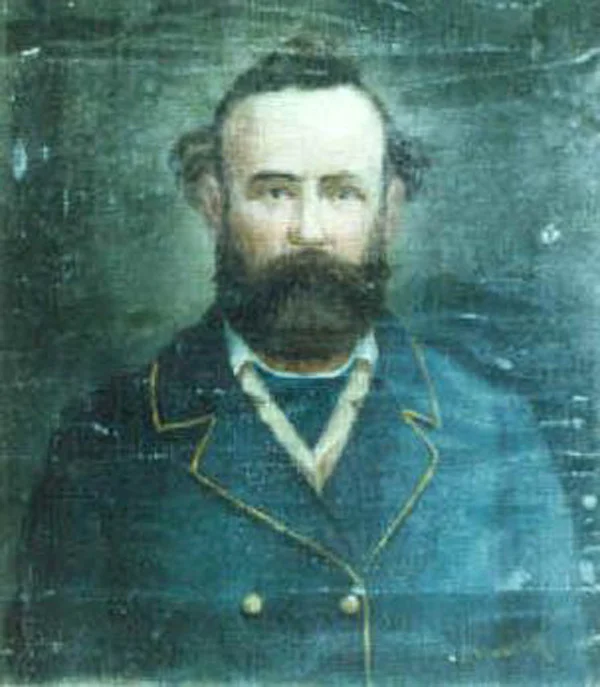
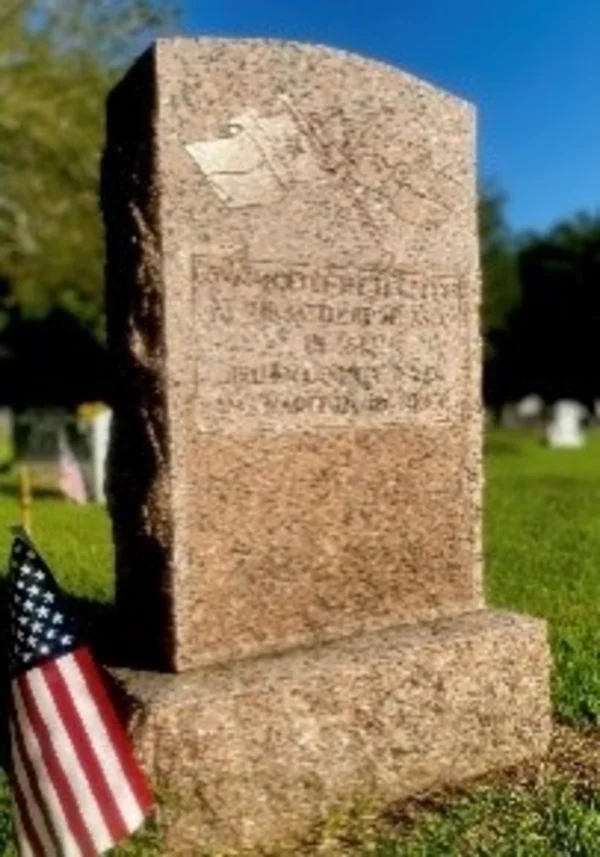
Old Columbia Cemetery can also boast state historical markers for early Texas pioneers Dr. Samuel Tubbs Angier, John Smith Davenport Byrom, Nathaniel C. Hazen, Byrd Lockhart and George Rounds, all of whom fought for Texas’s independence from Mexico.
Dugald McFarlane was born in Scotland in 1797 and immigrated to America at the age of 18. He arrived in South Carolina in 1815, married Eliza Davenport in Alabama and then came to Texas in 1830. According to a story on Dugald McFarlane on the Texas State Historical Association website, he received a land title grant from Stephen F. Austin in October, 1830, for 4,428 acres in Matagorda County. He signed the Goliad Declaration of Independence in 1835, served as a captain of artillery during the Texas Revolution, served in the Congress of 1844, and fought in the Mexican War in 1846.
McFarlane was listed as a school teacher in the 1850 census in Brazoria County. He was the postmaster of Matagorda County in 1860 when Dugald was living with his daughter, Eureka Theall, and her family. He died in 1861 and is buried at Columbia Cemetery.
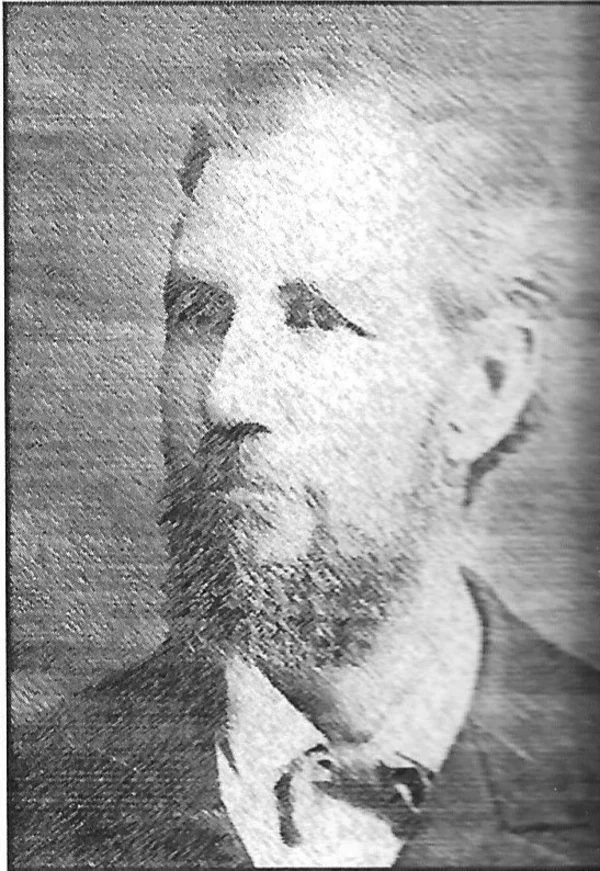
When the Anglos residing in Mexico’s Texas colony declared their independence March 2, 1836, Dugald McFarlane joined the Regular Texas Army and achieved the rank of 2nd Lieutenant of Company A, 1st Regiment Artillery stationed at Camp Independence, according to the TSHA online story on him. “As a member of Philip Dimmitt’s company at Goliad, MacFarlane signed the Goliad Declaration of Independence on December 20, 1835,” the TSHA story says. “During the Texas Revolution he was a captain of artillery, and in 1842 he was again in the Texas Army to participate in the campaign against Adrian Woll. He represented Matagorda County in the House of the Ninth Congress, 1844-1845, and in 1846 joined the United States Army to participate in the Mexican War.”
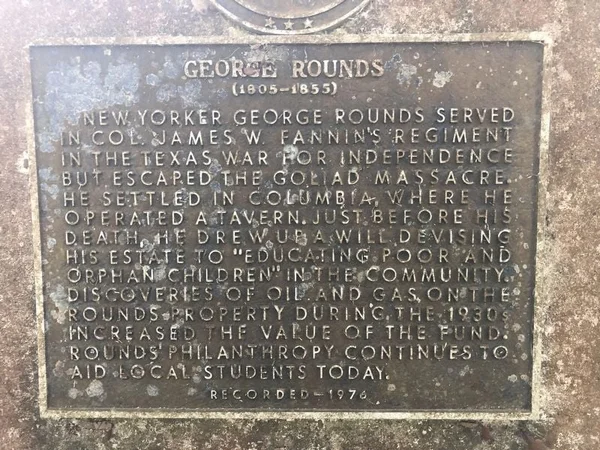
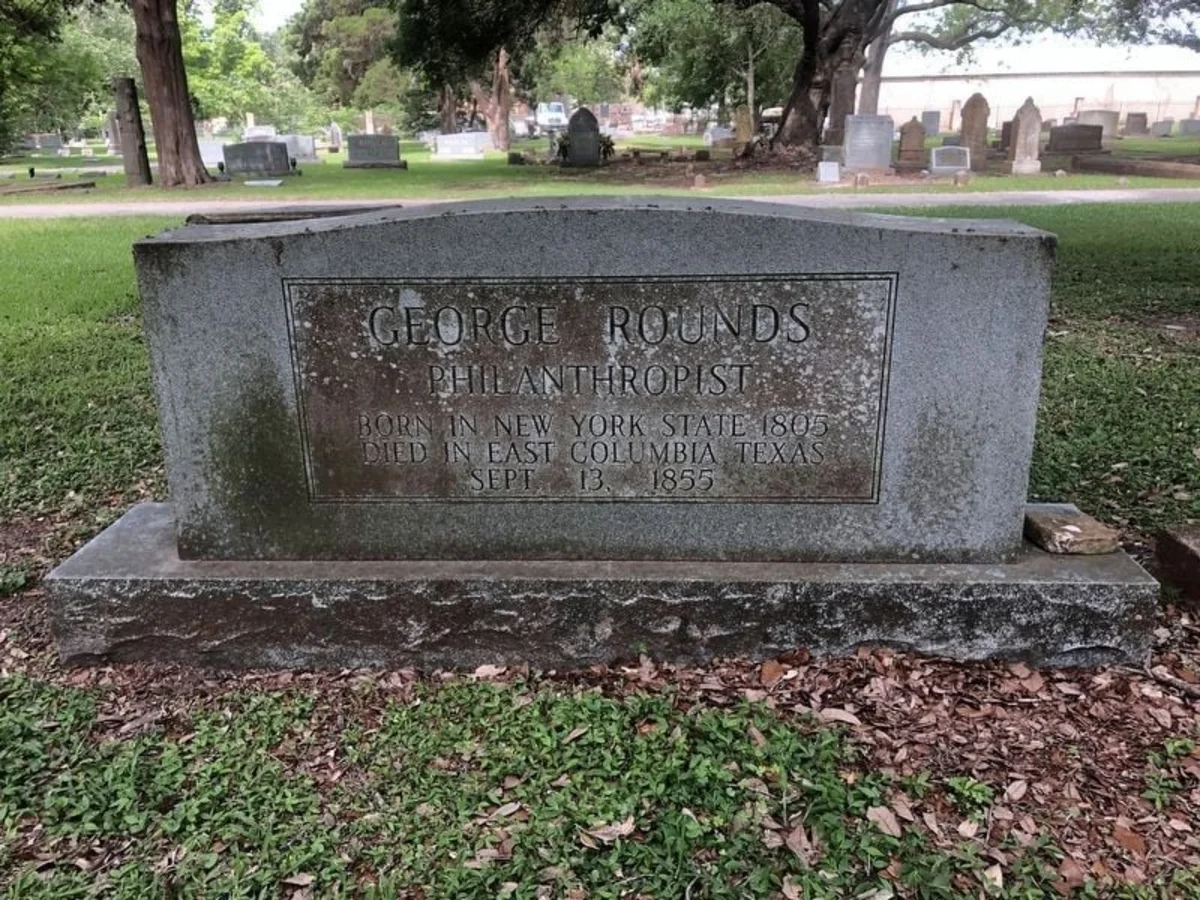
The stories of Nathaniel C. Hazen and George Rounds both involve surviving execution at Goliad with Colonel James Fannin’s soldiers in 1836. The Texas State Historical Marker at Columbia Cemetery honoring George Rounds reads: “New Yorker George Rounds served in Colonel James W. Fannin’s regiment in the Texas War for Independence but escaped the Goliad Massacre. He settled in Columbia, where he operated a tavern. Just before his death (in 1855), he drew up a will devising his estate to ‘educating poor and orphan children’ in the community. Discoveries of oil and gas on the Rounds property during the 1930s increased the value of the fund. Rounds’ philanthropy continues to aid local students today.” The George Rounds historical marker was dedicated at Columbia Cemetery in 1976 by the Texas Historical Commission.
Hazen’s story of escape from execution at the Goliad Massacre is detailed in the Texas State Historical Association’s website. I wrote about Hazen in a previous Columbia Historical Museum story, saying “As Texian soldiers routed General Antonio Lopez de Santa Anna’s Mexican troops at the decisive Battle of San Jacinto in April 1836, celebratory shouts of ‘Remember the Alamo’ and ‘Remember Goliad’ rained down on the fallen and fleeing Mexicans. One of those soldiers shouting victory is buried in the Old Columbia Cemetery. Private Nathaniel C. Hazen survived the firing squads at Goliad and lived to fight the Battle of San Jacinto.”
Hazen was able to escape when the bloodbath at Goliad began, and he found his way to General Sam Houston’s camp. He lived only until the end of that year, dying the same day as “The Father of Texas,” Stephen Fuller Austin, on December 27, 1836. Hazen was buried at Josiah and Mary Bell’s plantation at Columbia. He was only 28 years old.
The State of Texas erected a historical marker in Columbia Cemetery in memory of Hazen’s bravery in 1936 during Texas’s centennial.
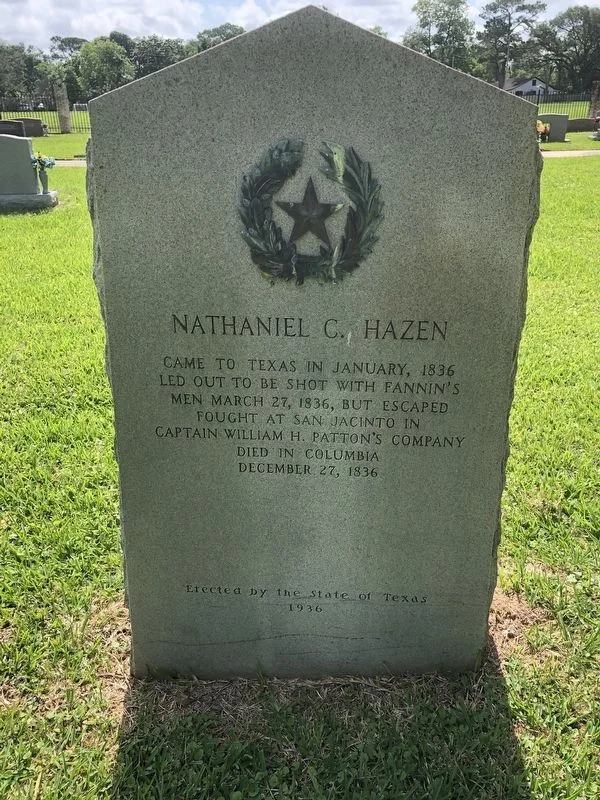
Twenty-eight Texian soldiers are believed to have escaped execution at Goliad, including Hazen. Nathaniel C. Hazen came to Texas in January 1836 but sadly died less than a week before New Year’s Day 1837. He participated in both the battles of Coleto Creek and Goliad under Colonel Fannin and the Battle of San Jacinto under the leadership of General Sam Houston who would later that same year be inaugurated as the first president of the Republic of Texas right here in West Columbia.
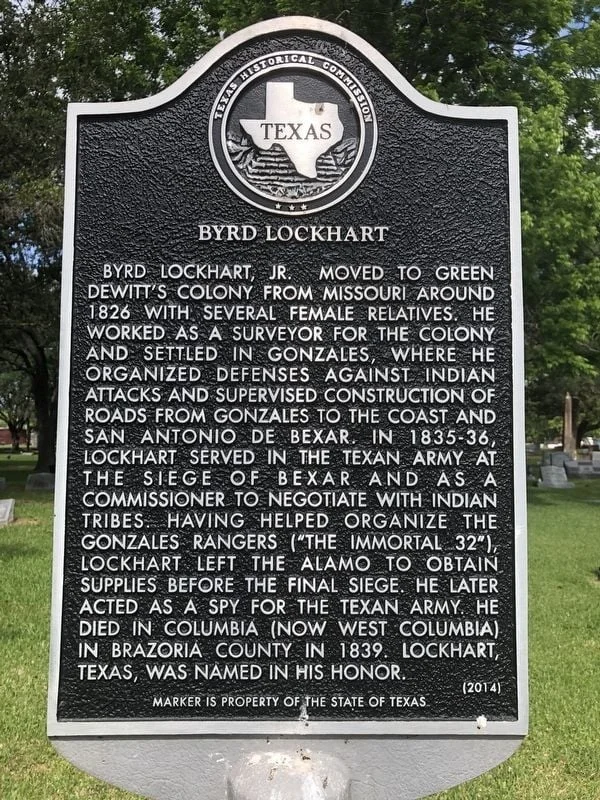
Byrd Lockhart was born in Virginia in 1782. At the outbreak of the Texas Revolution, Lockhart was requested by James W. Fannin Jr. to act as a scout below San Antonio de Bexar. At this time he was serving with Stephen F. Austin, but he became separated from Austin’s command near the Medina River on November 12, 1835, according to a story on Byrd Lockhart on the Texas State Historical Association’s website. During the Siege of Bexar, Lockhart served as a private, along with his son, Byrd Jr., in Captain John York’s company.
Byrd Lockhart was a widower when he moved to Texas from Missouri with his mother, sister and his two children. They settled in Green DeWitt’s colony on March 20, 1826.
As a soldier in the Texas Revolution, Byrd Lockhart arrived at the Alamo on March 1, 1836, as a member of the Gonzales Ranging Company. Luckily for him, Byrd was sent with Andrew Jackson Sowell to obtain supplies and the two were not at the Alamo when the famous garrison fell to the Mexican Army. The TSHA story says, “That they were delayed in Gonzales buying cattle and supplies saved them from being caught in the massacre when the Alamo fell. Lockhart later served the Texan army as the captain of a spy company.”
He died in 1839. The Texas town of Lockhart is named in his honor.
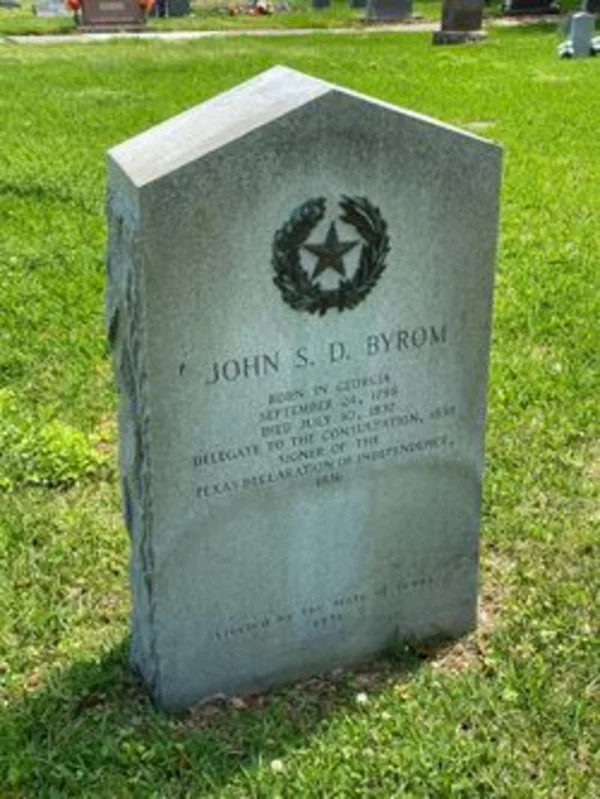
John Smith Davenport Byrom was born in Hancock, Georgia, on September 24, 1798. In 1830 Byrom came to Texas and settled in what is now Brazoria County. He participated in the Battle of Velasco on June 26, 1832. In 1835 he represented Brazoria at the Consultation and the General Council appointed him one of three commissioners to organize the militia in the Municipality of Brazoria. Byrom was one of the four representatives from Brazoria to the Convention of 1836 at Washington-On-The-Brazos. There he signed the Texas Declaration of Independence.
His state historical marker at Old Columbia Cemetery was, like that of Nathaniel C. Hazen, dedicated in 1936 during Texas’s centennial.
Byrom died on July 10, 1837, just a few months after the capital of the Republic of Texas was relocated from Columbia to Houston. He was buried on Josiah and Mary Bell’s plantation in Columbia where Columbia Cemetery is now located.
David McCormick, the son of Andrew and Catherine Adams McCormick, was one of Stephen F. Austin’s Old 300 Anglo colonists who came to the Mexican colony of Texas with Austin in 1821. He was born in 1793 in Hempstead County, Arkansas. A widower who lost his wife and two children in Arkansas, McCormick received title to a league of land in what is now Brazoria County on July 21, 1824. The census of 1826 classified him as a farmer and stock raiser.
“When the Texas Revolution began, David McCormick was among the men in Austin’s Colony who immediately headed for the recruiting station to offer their services,” wrote the late Marie Beth Jones in a Brazosport Facts story from 2015. “His nephew said that David was riding his fine gray saddle horse and carrying his trusty rifle. Though the officer in charge happily took the horse and gun, he deemed David too old, infirm and deaf to serve. Despite his angry protests, David remained at home to help take care of the families of those who were at the front.”
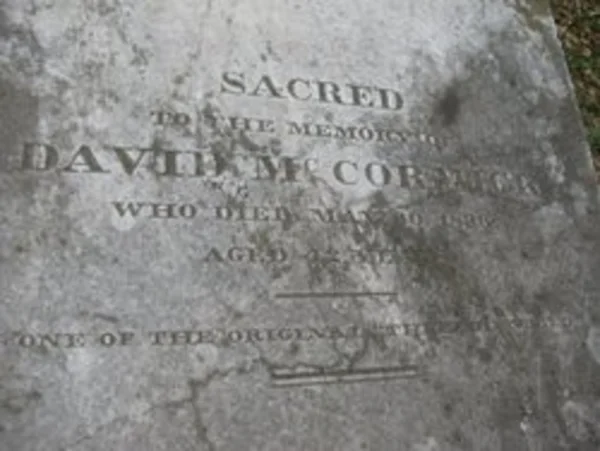
Jones went on to write in her “Tales From the Brazos” article in The Facts a decade ago, “Just a few weeks later, on May 30, 1836, he died at the age of just 42 years, and was buried near his home (at the mouth of the Brazos River). His remains were later moved to the West Columbia cemetery, where his marble grave marker notes that he was one of Austin’s Original Three Hundred.”
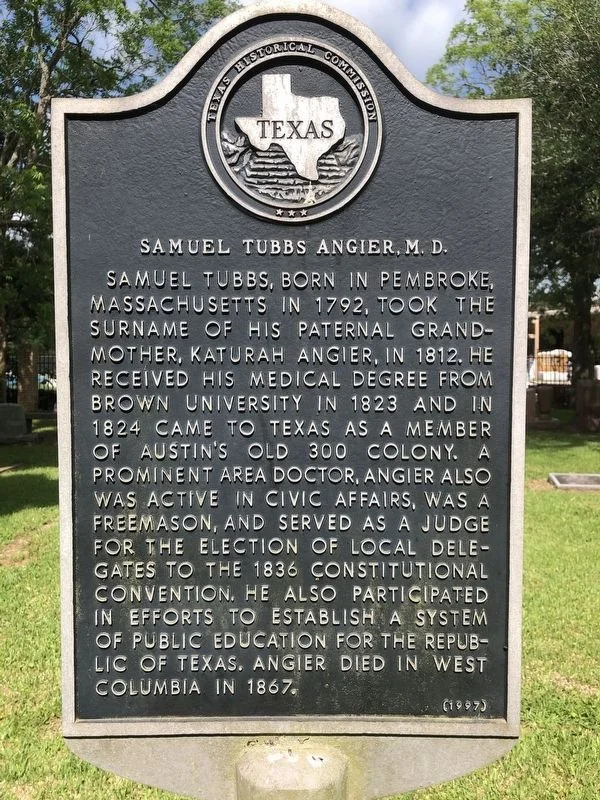
Dr. Samuel Tubbs Angier, another of Austin’s original Old 300 colonists, was born in Pembroke, Massachusetts, on August 26, 1792, the son of Samuel and Mary Tubbs. In 1812 he changed his name to Samuel Tubbs Angier, “taking as his surname the maiden name of his paternal grandmother, Katurah (Angier) Tubbs,” it is written in a Texas State Historical Association website story on Dr. Angier.
He received a large plat of land on Chocolate Bayou’s west banks in what is now Brazoria County in 1824, as well as a labor of land on the east bank of the Brazos River four miles above its mouth. Angier was one of four established physicians in Brazoria in the 1830s. According to Columbia Cemetery Association records, Dr. Angier served in the Army during the Texas Revolution. He also served as an election judge for Brazoria Municipality when delegates were chosen for the Constitutional Convention of 1836, which was to convene at Washington-On-The-Brazos.
Dr. Angier died in West Columbia on April 17, 1867, and was buried at Columbia Cemetery. He was selected grand master of the local Masonic lodge in 1848 and served as the lodge treasurer in 1849 and 1850. Dr. Angier’s state historical marker was dedicated at Old Columbia Cemetery in 1997.
In a Sons of Dewitt Colony Texas online story about Captain Henry Stevens Brown, it is stated that “Captain Brown was a true pioneer in the nobility and magnanimity of his nature; unselfish and generous, one who rejoices in the preventing and despised the stirring up of personal strife among men.”
That story, written by Mrs. C.A. Westbrook in 1925, says, “In 1831, Captain Brown located at Columbia, Brazoria County. Soon afterwards the contest arose between the colonists and the Mexican garrisons at Nacogdoches, Anahuac and Velasco, and particulars of which pertain to the history of the country. And as Captain Brown was always the first in war, we find him among the first volunteers to attack Anahuac.”
It goes on to say that Captain Brown’s company was composed of “some very prominent men. Edwin Waller, Robert Mills, the distinguished merchant, Dr. Charles B. Stewart and others. The most of Captain Brown’s company was composed of boys, but his cool courage and daring bravery seemed to inspire them with a heroism worthy of veterans.”
Speaking of his death and burial, Mrs. Westbrook went on to write: “On the 26th day of July, the soul of Henry S. Brown crossed the river, in the foty-second year of his checkered life. His attending physician was Anson Jones, afterwards president of Texas. Captain Brown’s remains were interred in the cemetery of the Bell family (now Columbia Cemetery), in whose presence he breathed his last. He sleeps beneath the shades of a majestic live oak besides the once noted Captain Byrd Lockhart.”
A separate story will follow on the Columbia Historical Museum’s website about Thomas Dodson Cayce, who is also buried at Columbia Cemetery in West Columbia and was involved in the Texas Revolution.