
By Tracy Gupton
“On July 23, 1836, David Burnet called for an election to be held in September, at which time officials for the first regular administration of the Republic of Texas would be elected, and he named Columbia as the new capital,” is written by the late Beth Griggs in the West Columbia Chamber of Commerce’s 1997 History, Community Profile and Membership Directory. “The thriving trade from the river port, and the additional facilities built while it was the seat of the courts, had caused much growth in Columbia. One of the few hotels in the area was found in Columbia, as well as a number of rooming houses – Polley’s Rooming House, a tavern run by Fitchett and Gill for Josiah H. Bell, and a boarding house operated by Rachel Carson and Ammon Underwood at Bell’s Landing – to name a few. At this time, Columbia offered more space available than any other town in Texas, with the possible exception of Nacogdoches.”
Beth Griggs, who lived to be 99 years old, was a noted historian of West Columbia’s past. In the 1997 Chamber of Commerce Buyer’s Guide that is kept in the vault at the Columbia Historical Museum, she wrote, “Obviously, there was no single building large enough to hold the entire government. Two buildings served primarily to house the Congress and offices of the officials, and a number of smaller log houses were used as offices and committee rooms. A.P. McCormick writes that the president most often used a log cabin known as the office in the yard of Josiah H. Bell’s home.
“One building in which Congress met was built by Captain Henry S. Brown in 1832, and served as his family residence until his death in 1834. This was a two-story building located on the south side of Brazos Avenue, containing two rooms below and two above, separated by a large hallway, with an ell to the back. After Captain Brown’s death the building was occupied by the firm of W.C. White and Company, composed of Walter C. White and James Knight. This building was destroyed in 1888.”
A Texas state historical marker dedicated to the memory of Captain Henry S. Brown marks the location of his grave at Columbia Cemetery.
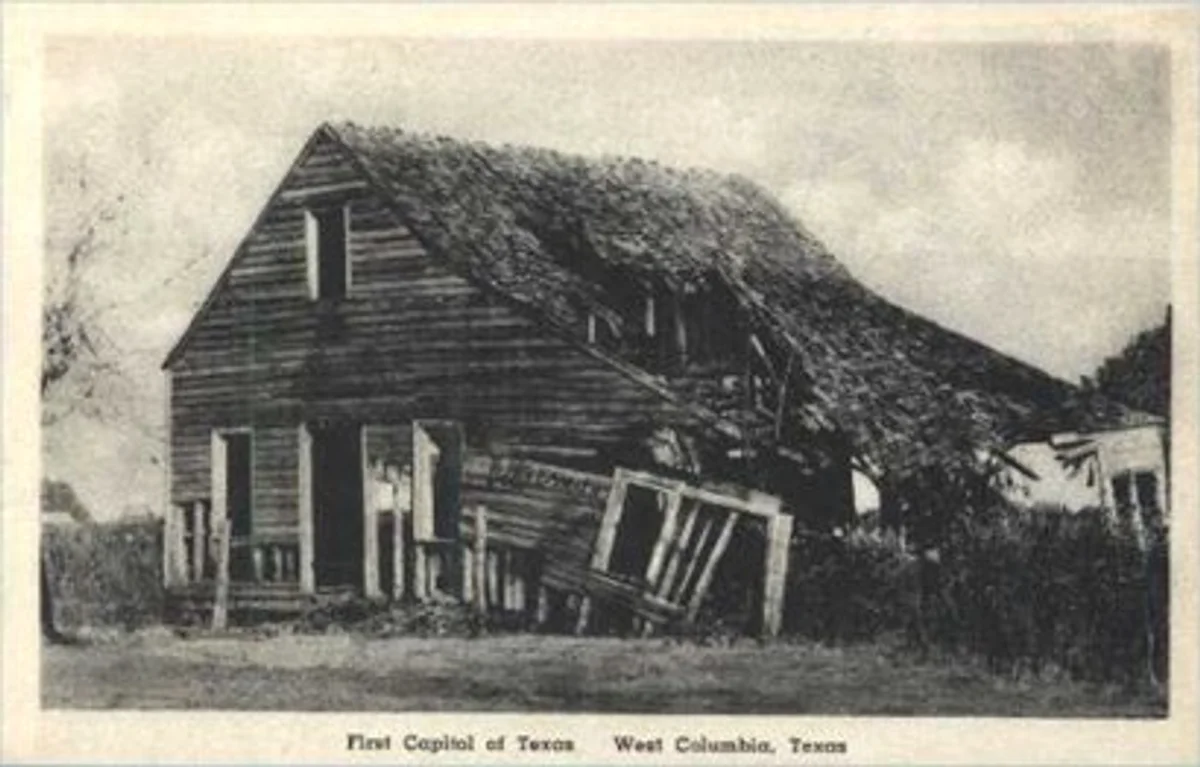
“The other building which housed Congress,” Mrs. Griggs went on to write, “was a store built by Leman Kelsey in about 1833. It stood on the north side of Brazos Avenue, almost across the street from the Brown house. One body of Congress met in the large central room, and Stephen F. Austin had his office in the shed room at the back.”
Beth Griggs wrote that “This Kelsey building is the one referred to by old timers in the area as the “old capitol” and it is the one generally pictured in history books.” The Columbia Historical Museum has several drawings and photos of the “old capitol” building on display.
John Adriance, who Mrs. Griggs referred to as “an early settler who lived at Columbia in the days of the Republic,” often referred to the Kelsey building as “the old capital” and to the Brown house as the senate building. John Adriance is also buried at historic Columbia Cemetery. Mrs. Griggs wrote that “The Kelsey building was destroyed by a storm in 1900.” The first capital replica located near the West Columbia Chamber of Commerce office and the West Columbia American Legion Hall is planned to be moved to the downtown block across East Brazos Avenue from the Columbia Historical Museum. An October 17th deed transfer ceremony at Heritage Hall in West Columbia gave the majority of that city block to the Texas Historical Commission to use as a new First Capitol-Columbia 1836 state historic site.
“There was a great influx of people when the government officials arrived,” wrote Beth Griggs. “The ad interim cabinet, the newly elected officials, the judiciary, and the army and navy looking for back pay, the great, the near great and the hangers on, all gathered.
“The election had been called to deal with election of officials, and ratification of the constitution. Sam Houston was elected president, Mirabeau B. Lamar vice president, and Stephen F. Austin was selected secretary of state. Under Mexico, Texas had been divided into municipalities, which became counties under the Republic of Texas. Twenty-nine representatives and fourteen senators were chosen, and this first duly elected congress of the Republic met at Columbia, October 3, 1836. Each house organized itself, with Ira Ingram being elected speaker of the house, and Richard Ellis selected as president of the senate.”
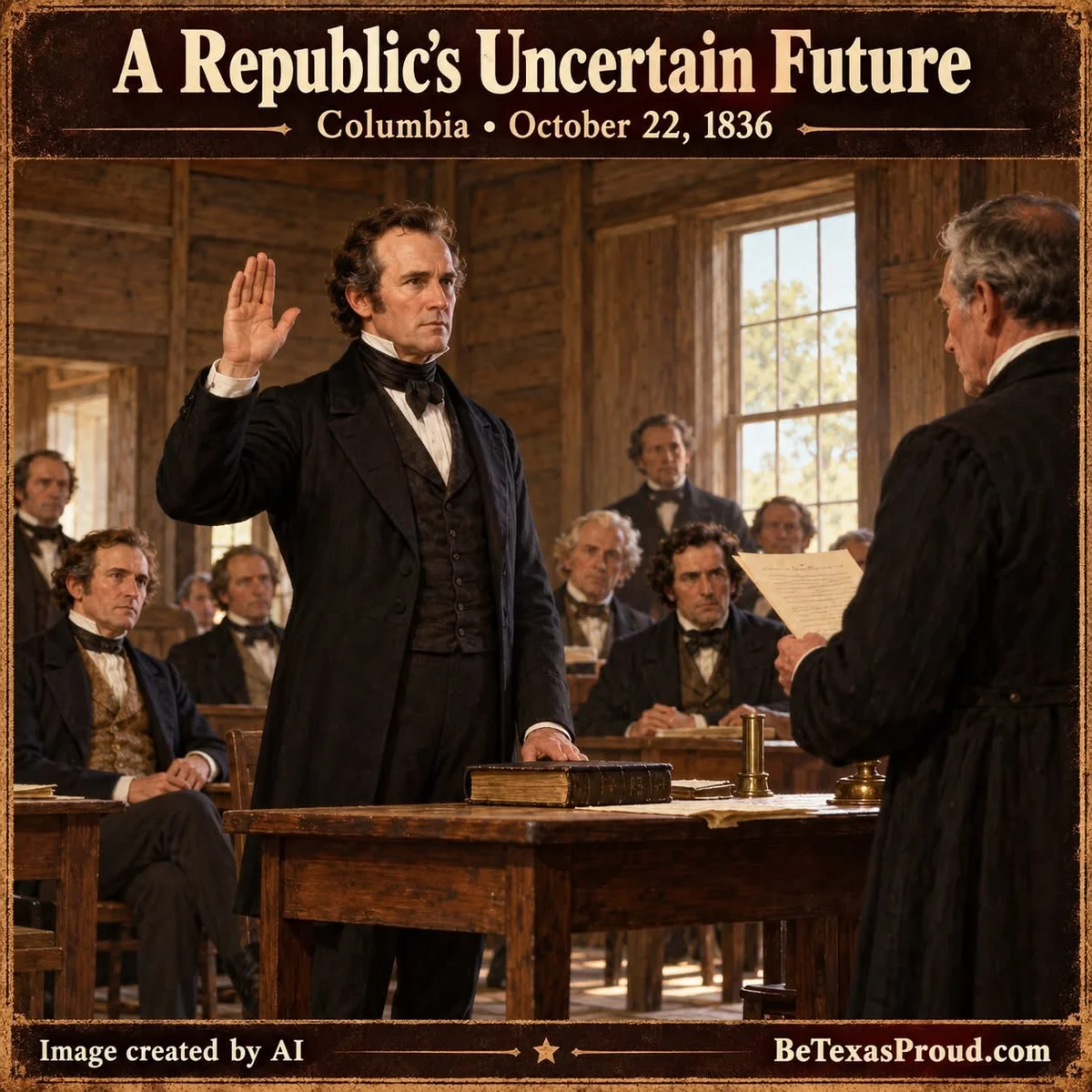
Mrs. Griggs went on to write that “The legislature voted to inaugurate the newly elected officials sooner than planned” on October 22, 1836. “In as much as the inauguration was rushed up, Houston’s speech was somewhat impromptu, but he was equal to the occasion, delivering a stirring speech. He unbuckled his sword, the emblem of his past office, and with tremendous emotion, presented it, stating:
“I have worn it with some humble pretensions, in defense of my country, and should the danger of my country again call for my services, I expect to resume it and respond to that call, if needful, with my blood and my life.”
In her “A History of Brazoria County,” published in 1958, Mary Nixon Rogers wrote about the October 22, 1836, swearing in ceremonies: “The senate and house of representatives buildings were surrounded by giant live oaks. One tree, especially noted for its size and triple trunk, became known as the ‘Independence Oak,’ for under its spreading branches men famous for their deeds in Texas history met and heard the reading of the Declaration of Independence. Here President Burnet delivered his farewell message, and the newly-elected officials were installed — Sam Houston, Mirabeau B. Lamar, Stephen F. Austin, Henry Smith, Thomas J. Rusk, Samuel R. Fisher, James P. Henderson, Robert Barr, and William H. Wharton. Visitors gathered from all points to witness their outstanding event and to hear the inaugural addresses.”