

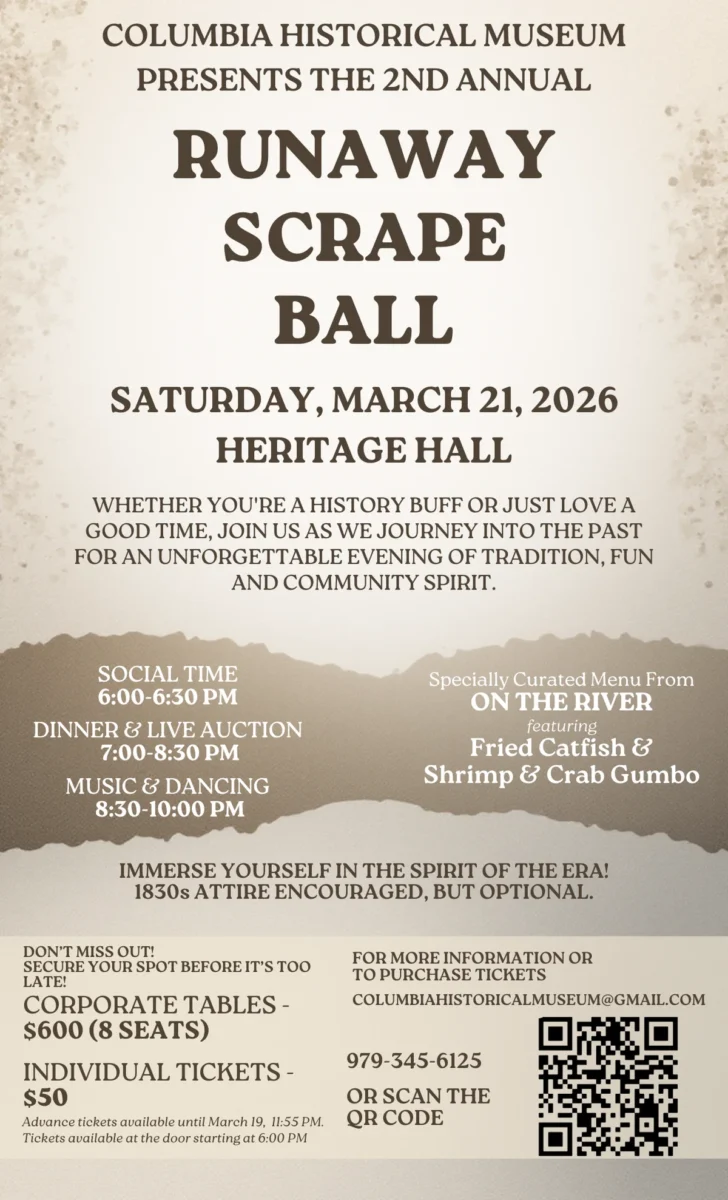
The Second Annual Runaway Scrape Ball hosted by the Columbia Historical Museum will be held at West Columbia’s Heritage Hall Saturday, March 21st. The event was created in 2025 as a fundraiser and the directors of the local museum hope to make the Runaway Scrape Ball an annual event for years to come. Tickets to the ball are $50 each and can be purchased at the museum, 247 East Brazos Avenue in downtown West Columbia, or can be obtained from any museum board member or at the door the night of the event.
The term Runaway Scrape was the name Texans applied to the flight from their homes when Mexican President Antonio Lopez de Santa Anna began his attempted conquest of Texas in February 1836. According to the Texas State Historical Association, the first communities to be affected were those in the southcentral portions of Texas around San Patricio, Refugio, and San Antonio. “The people began to leave that area as early as January 14, 1836, when the Mexicans were reported gathering on the Rio Grande,” states the TSHA online entry about the Runaway Scrape [https://www.tshaonline.org>handbook>entries>runaway-scrape]. “When Sam Houston arrived in Gonzales on March 11 and was informed of the fall of the Alamo, he decided upon retreat to the Colorado River and ordered all inhabitants to accompany him. Couriers were dispatched from Gonzales to carry the news of the fall of the Alamo, and when they received that news, people all over Texas began to leave everything and make their way to safety.”
The TSHA goes on to say that Houston’s retreat marked the beginning of the Runaway Scrape on a really large scale. Washington-on-the-Brazos was deserted by March 17, and about April 1 Richmond was evacuated, as were the settlements on both sides of the Brazos River. The further retreat of Houston toward the Sabine left all of the settlements between the Colorado and the Brazos unprotected, and the settlers in that area at once began making their way toward Louisiana or Galveston Island. The section of East Texas around Nacogdoches and San Augustine was abandoned a little prior to April 13. The flight was marked by lack of preparation and by panic caused by fear both of the Mexican Army and of the Indians. The people used any means of transportation or none at all. Added to the discomforts of travel were all kinds of diseases, intensified by cold, rain, and hunger. Many persons died and were buried where they fell. The flight continued until news came of the victory in the Battle of San Jacinto. At first no credence was put in this news because so many false rumors had been circulated, but gradually the refugees began to reverse their steps and turn back toward home, many toward homes that no longer existed.
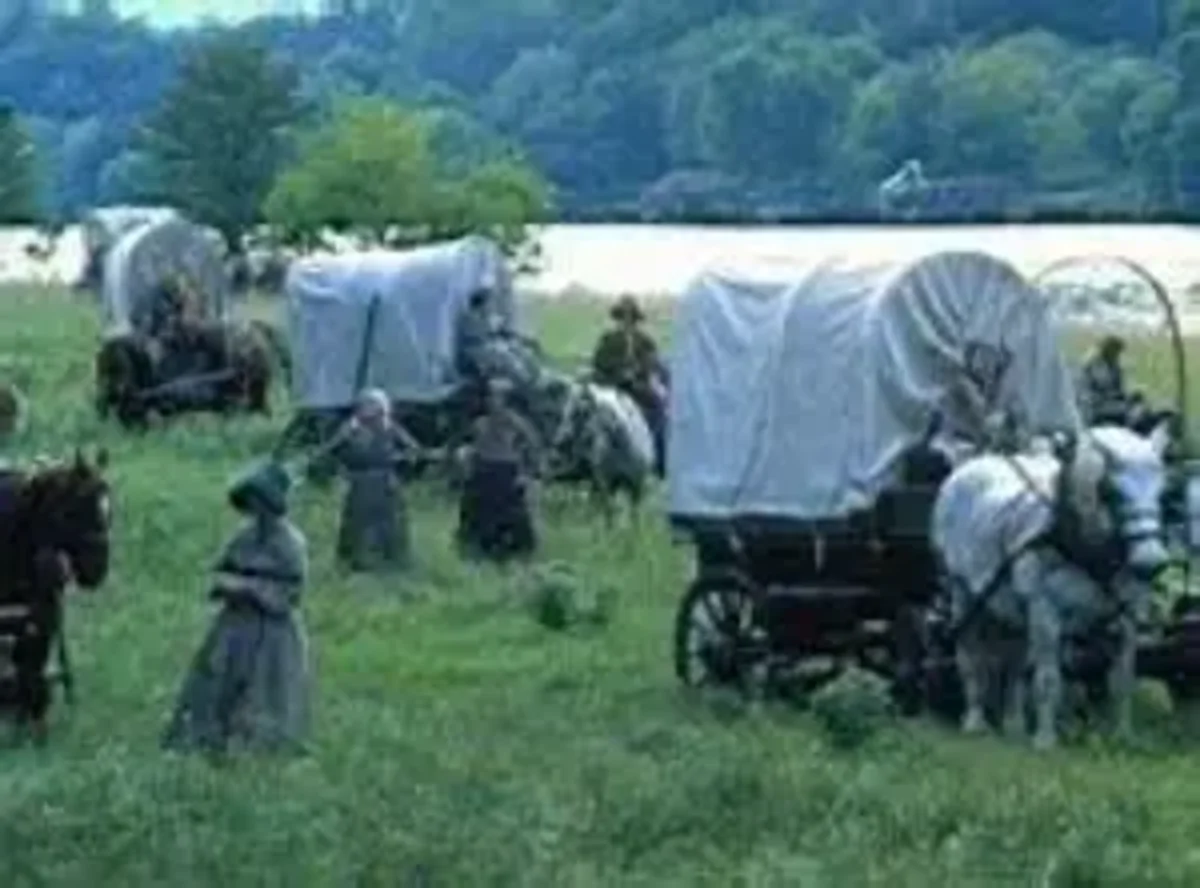
Former West Columbia High School teacher James “Deacon” Creighton wrote in his 1975 “A Narrative History of Brazoria County” that not all West Columbia area residents fled their homes at this time. “Out at Bailey’s Prairie near Columbia, where John Thomas and his wife, Ann Raney Thomas, had settled, having bought the Brit Bailey place after Bailey’s death, Thomas decided to wait until the last moment before abandoning his property and joining the others fleeing to the Sabine. In fact, evacuation of Brazoria County by some families had been under way for nearly two weeks before Thomas started. Confusion and haste followed.”
Creighton wrote that, “As the news spread of the fall of the Alamo, a tidal wave of stark terror and unreasoning fear swept through the country. When word came that Houston’s army was retreating toward the San Jacinto, residents in the settlements between the Colorado and the Brazos rivers realized that they were no longer protected. Women, children, pack mules, servants — a throng which stretched as far as the eye could see — streamed eastward from the settlements on the Colorado and the Brazos. Part of this group wound up at Galveston, in temporary shelters of calico and sheeting. Part, including the James F. Perrys, gathered on the banks of the San Jacinto, where a miserable pool of five thousand people waited to be ferried across. There Mr. Perry left his family and started for Galveston to join the command of Colonel Morgan.”
James F. Perry was Stephen F. Austin’s brother-in-law and lived with Austin’s sister near present day Jones Creek in what today is Brazoria County. When Stephen Fuller Austin died of pneumonia December 27, 1836, in Columbia, his body was transported by ship down the Brazos River from Bell’s Landing (present day East Columbia) to Brazoria where “The Father of Texas” was taken to the Perrys’ plantation for burial at Peach Point.
“To keep from overloading his wagon, ” Creighton wrote about John Thomas, “he permitted only the most necessary articles to be taken, limiting even clothing to one change of clothes per person. But nevertheless his wife, Ann, managed to pack aboard a wagon her set of fine china from England without her husband’s noticing. Later, when the little trunk containing the china had to be abandoned beside the road, it was the loss of this one article which seemed to personify to Ann all the miseries of her experience in the Runaway Scrape.”
At the town of Columbia, Creighton went on to write, the same process of evacuation was taking place (in March 1836, 190 years ago this month). Nearly all of the residents, including the Josiah H. Bell family, went down the Brazos by steamboat to Galveston. Josiah and Mary Bell were members of Stephen F. Austin’s Old 300 who founded the communities of Marion (present day East Columbia) and Columbia (present day West Columbia). “However, Catherine Carson (another member of Austin’s Old 300 settlers), remained behind with her daughter, Rachel. At the time of the Runaway Scrape, both of her sons were with the Texas Army. Her concern for them made her reluctant to leave with the other colonists. Finally, she realized that she and Rachel would have to seek safety. Together they went to the Mound (Damon’s Mound), where they joined the Damon family and fled on to Richmond, Texas. Here they expected protection from a company of Texas soldiers stationed at Fort Bend to protect families crossing the Brazos.”
Creighton wrote that, “The plan did not work out. The Mexicans forced a crossing of the Brazos and began firing at the refugees. Catherine Carson helped to load the wagons as the bullets were flying overhead. From the vicinity of Richmond the refugees in this group continued their flight until they reached what is now Montgomery County, about 12 miles from the Trinity River. On April 21, they heard the cannon firing at San Jacinto and thought it was thunder.”
According to Deacon Creighton, “On April 21, 1836, General Urrea’s forces reached Columbia, which he found deserted. The next morning he rushed on to Brazoria, arriving about ten o’clock in the morning. Here, according to Urrea’s statement, he found the inhabitants reasonably cooperative and he responded with a conciliatory policy. This policy, however, did not extend to the Masonic Lodge at Brazoria, as Urrea destroyed the lodge records, books, jewels, and all else that belonged to the lodge with the exception of the charter. The charter was not destroyed because it wasn’t there. It had been brought to Texas by James M. Allen, who turned it over to Anson Jones as Jones was on his way to the Battle of San Jacinto.”
According to Creighton’s book on Brazoria County history, Anson Jones carried the charter in his saddlebags throughout the battle at San Jacinto and “it was thus saved from destruction.”
As for John Thomas, Creighton states in his book that after crossing the Sabine River into Louisiana during the Runaway Scrape, Thomas declared he would never return to Brazoria County. “Later, he told his wife that at the town of Liberty on the Trinity he had sold all his land and property to Edwin Waller for two thousand dollars, although he had paid nine thousand for it.”
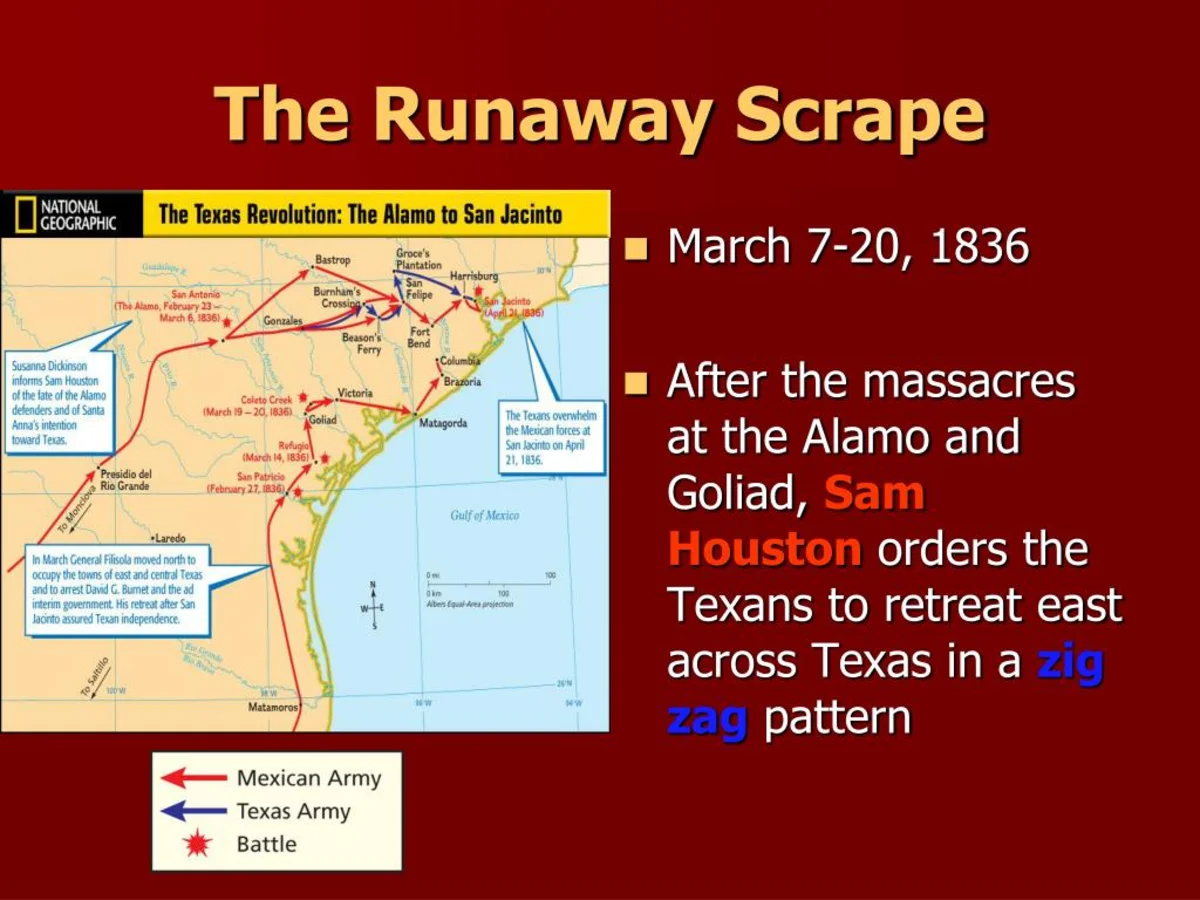
Author H.W. Brands writes about the Runaway Scrape in his 2004 book, “Lone Star Nation,” that “Rumor traveled on the wind, and often got distorted in the transmission. Listeners imagined the worst and, in the absence of calming evidence, acted on their imagination. In many cases the men had gone off to fight; those who went to the Alamo and Goliad wouldn’t be coming back, and their families typically had no one to protect them.”
Brands wrote that, “Whatever the prudence of retreat, the decision (by Sam Houston) to fall back unnerved the populace, which had been counting on Houston to hold the line at the Guadalupe. Things got worse. News arrived of the disaster at the Alamo; this was followed by wild rumors of massacres of men, women, and children along the Guadalupe. Panic seized the entire populace. The exodus was rendered more difficult, and the panic intensified, by the fact that the flight occurred in late winter. Beyond this, late winter was the mud season, when roads turned to gumbo, especially under heavy traffic. Finally, many of the settlers lacked efficient wheeled transport; clumsy, homemade carts were common, straining the draft animals all the more.”
Echoing what James Creighton wrote about the difficult efforts to flee the oncoming Mexican armies, Brands wrote that “disease descended on the refugee columns. Measles and other contagions laid many low and carried the weak away. The dying received no shelter, succumbing beneath the heedless sky at the edge of the road, where they were buried in hasty graves and forgotten by all but their kin.
“Yet at times the exodus brought out the best in the living,” Brands wrote. “A woman with four children had lost her husband in the Alamo; she became a mother for the fifth time just as her party was crossing the Colorado.”
The author of “Lone Star Nation” said that many men from the army “had abandoned their soldierly duties” to assist their families and neighbors in the exodus from Texas towards Louisiana. “But enough stayed with Houston to make the flight an affair mostly of women, children, and old folks.”
Tickets to Saturday’s Runaway Scrape Ball at Heritage Hall in West Columbia can also be purchased by hovering your cell phone camera over the QR Code at the bottom of the promotional flyer below. Donations to the Columbia Historical Museum can also be made in this manner. There will be a catered meal, both live and silent auctions and music for dancing at the March 21st gala which will begin at 6 p.m. and conclude at 10 p.m. Everyone is invited and 1836 period clothing is merely a suggestion. For more information about the Second Annual Runaway Scrape Ball at Heritage Hall, contact the museum at (979) 345-6125.
West Columbia’s museum, housed in the old First Capitol Bank building downtown, is open every Thursday, Friday and Saturday from 10 a.m. to 2 p.m. Tours of both the museum and the historical Rosenwald School, located directly behind the museum, can be scheduled by appointment. Contact the museum manager Sally Reuffer for further details.
I really enjoyed reading this account of our Texas history. As usual, Tracy has done an outstanding job and service for our museum.